The day before their Nara wedding, we were laughing with them beneath the autumn trees in Kyoto. She wore a white knit dress; he wore a camel coat over a white turtleneck and jeans. There was a canal to walk beside, a very large temple gate ahead, and no reason to turn the morning into anything other than time together in Japan.
The following day would bring a waterfall blessing, vows above a mountain garden, sake and live music in a tatami room. Just the two of them, with an entire wedding shaped around that fact. They were fabulously good company, and there was room in these two days for both the significance of marrying and the pleasure of being away together.
We loved having that time with them. Wandering through Kyoto with people whose company you enjoy is already a rather lovely way to spend a morning. Getting to photograph their wedding the next day makes it more personal still. There’s something wonderful about arriving at a ceremony already knowing the sound of a couple’s laughter, recognising the little expressions that pass between them. That familiarity matters to the photographs. It matters to us, too. We get quite invested in the happiness of the people in front of our cameras.
Kyoto, at Walking Pace
Gion Shirakawa was bright that morning. Low sun crossed the stone paving, and the dark wooden fronts of the machiya held deep shadows. Willows were still green above the canal, while cherry and maple leaves had begun turning yellow and orange.


We followed the lanes, working with doorways, a white wall striped by branches, and the vermilion fence of a shrine. They laughed beneath the leaves. At the canal, they stood together on a single stone-slab bridge, with the hills visible beyond the narrow passage of water and buildings.


A Kyoto pre-wedding shoot can give a couple an experience with its own shape, especially when it leaves room for walking and conversation. The city keeps offering changes in scale: a lantern, a quiet stretch of wall, the sudden height of a gate. You look up together, then turn back towards the person beside you.
At Chion-in, that looking up becomes fairly unavoidable. Its Sanmon gate was built in 1621, with two storeys rising roughly twenty-four metres above the approach. It is one of Japan’s largest surviving wooden tower gates, carrying an expanse of tiled roof that makes the people on its steps look wonderfully small.

There’s a particular pleasure in photographing a couple at that scale. We can give the architecture its full presence and still make the relationship legible: two figures standing close, an embrace within a timber gateway, the movement of people up a long stone stairway. The setting can be immense without losing the intimacy of what is happening inside it.

Chion-in has received people for centuries, for reasons far beyond ours. Spending time there asks you to take in something that existed long before your arrival, while your own small experience of it begins. For these two, that experience now includes the morning before they married.
Water Before Vows
By the next morning, we were in the mountain country around Nara and Mie. Mist sat among the forested ranges. The couple wore hiking jackets on the path at Akame 48 Falls, where there was a blessing before the wedding.

The path moved beside the water, past a plunge pool and along a log walkway, with moss under the maples. Orange leaves brought colour into the grey morning. Before there was a dress or a suit, there was this walk into the forest together.


Akame has long associations with mountain ascetic practice. The name, meaning red eyes, is connected to a legend involving En no Gyōja and a red-eyed ox. That history belongs to the place; their own morning there was a brief part of a much longer relationship between people and these mountains.
They had given part of their wedding day to being outside, on a path beside moving water. The body remembers a place through the walk as well as the view, through the coat you needed and the ground beneath your feet.
Late autumn was present in all of it. The colour, the mist and the need to put another layer on would follow them back to the villa. Choosing the season had helped shape the experience they could have.
A Nara Wedding Above the Garden
Sasayuri-Ann’s OZUNU villa sits in Fukano, in the Murou area of Uda. A thatched house looks across a rock garden, sculpted pines and the ranges beyond. On the grounds is a restored century-old tea room, with its own garden and a round window beside the koi pond.
This is a soul place for us. Part of the pleasure of coming back is seeing how each of our couples makes it their own. You can arrive knowing exactly where the light will fall and still have absolutely no idea what someone is going to do that makes you laugh. This groom began in a sweatshirt announcing GROOM. We appreciated the clarity.
Later, he tied his tie beside a round window, wearing a burgundy suit. The bride’s strapless gown and long train spread across the checkerboard tatami. They had their first look in the garden, then stood together on the wooden terrace to exchange their vows, with an iron lantern overhead and the mountains behind them.


Their words remain theirs. We can show the place in which they spoke, the two people turned towards each other, and the room the day had made for them. A photograph can hold the circumstances of something private without asking to possess its contents.
An elopement gives a couple considerable freedom over where their attention goes. With no guests to move between, they could keep returning to one another, and to the experience they were sharing. A Nara wedding of this size still has ceremony, preparation and care; those things are simply concentrated around two people.
That concentration can make ordinary gestures more noticeable. The act of dressing for each other, crossing a garden to meet, or sitting down together afterwards has space around it. The day can register in detail.
Music for Two People
The couple had specifically asked to add live musicians. A koto player in pink kimono and a shakuhachi player in black performed in the tatami room, with candles and a scroll behind them. Beyond the open doors and the irori hearth, the ranges were still visible.


We loved that they asked for live musicians. A performance for the two of you, in a tatami room with the mountains beyond the open doors. That is our kind of extravagance. There’s something deeply satisfying about giving an experience this much room in your wedding: time to settle into the music, to notice the person making it, to let a piece finish without already thinking about where you need to be next.
The musicians bring years of practice into that room. The couple give them their attention, and for a while there is this small, shared world between the people playing and the people listening. We get excited about things like this. They’re the experiences that make us want to keep finding ways for our couples to spend time in Japan, because there is so much here worth slowing down for.
For us, the hands matter as much as the wider view. The fingers on the bamboo flute, the relationship between an instrument and the person who knows it, the couple within listening distance: those details tell us how an experience is being made. A wedding can become particular through the people whose work enters it, even when its guest list contains no one else.
Afterwards, there was sake from a small cask marked with the character for celebration. Matcha was whisked in the tea room by candlelight, and they cut a small matcha cake at the table. The celebration had found a scale at which each of those things could be enjoyed in its own right.

The round window framed a kiss, with the koi pond in front of the thatched tea room. Elsewhere, it framed the garden or a figure standing in the light. A window makes a selection, drawing attention to part of a view while the rest continues beyond it.

That felt especially apt here. The couple had chosen a small part of Japan and given it enough time to become familiar: the route through the garden, the view from a room, the place where they would stand to marry. They could carry away something more specific than an impression of the country.
The Shape of Their Own Day
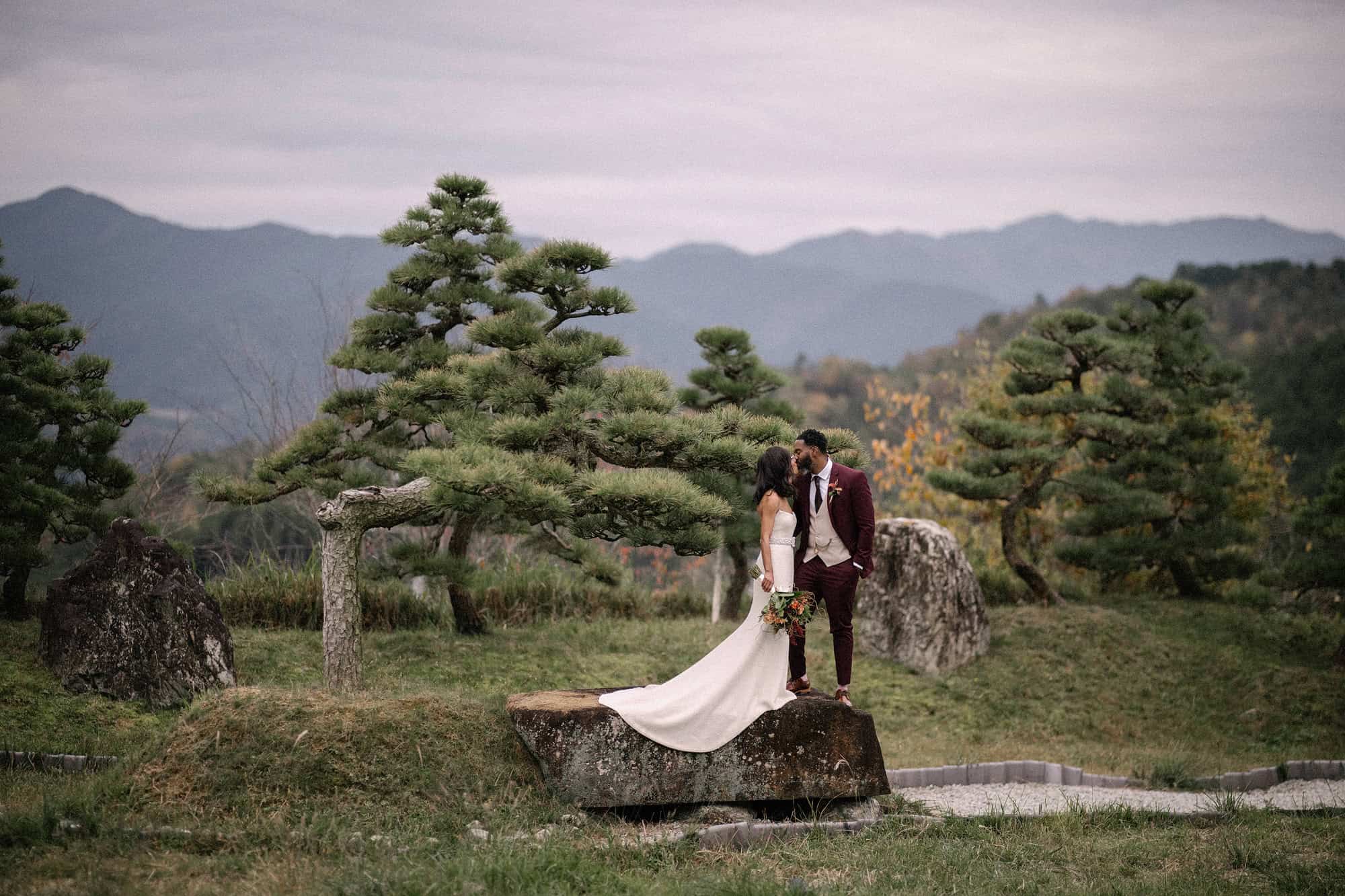
We photographed them on a flat rock among the pines, with the mountains rising behind. They walked through long grass, the bride in a white wrap coat, then stood beneath a maple at full yellow. A denim jacket appeared over the wedding dress later, because late autumn has a perfectly clear opinion about what people should wear outside.


There were portraits beside a bamboo gate and a tiled garden wall, and time looking across the rock garden together. The day remained grey and still. Colour came from the maples, the suit, the landscape itself, with the white dress moving through it.

We’ve written about what it means to live inside the world you choose for an elopement. Here, that meant allowing Kyoto and the mountains to become experiences, with time to walk, listen, eat and be together. The wedding could hold all of it without needing to turn every part into a ceremony.
Our planning team helped bring the arrangements together, and we photographed and filmed both days. The work followed the couple from the bright city morning to the quieter light of the mountains, keeping their ease and humour alongside the formal parts of the celebration.
Kyoto and Nara, in the Film
The highlight brings the two days into conversation. A hand on the shakuhachi, water falling through the forest, the bride beside the round window, then the light and movement of Kyoto. Matcha, the cake, the garden and that extremely informative sweatshirt all have their place.
Set to “Nervous” by John Legend, it returns to the things that gave their Nara wedding its own character. The city and the mountains can appear together because they belong to the same experience.
At the end, their silhouettes stand behind the round latticed window. We’ve spent two days seeing their faces, their laughter and the way they are together; now the light gives us just their outlines. By then, we know enough to recognise them.

That is part of what we hope to make when we photograph a wedding for two. Images with enough understanding inside them that even a silhouette can feel particular. A circle of light, a house in the mountains, and the people whose time there made it theirs.