The Japanese word for tourism is kankō. It’s usually traced to a line in the I Ching, the Chinese Book of Changes: to look upon the light of a country. The same line speaks of being received as the king’s guest.
To see a place at its brightest, and to be welcomed into it. We haven’t found a better description of travel. It describes a wedding in Japan just as well.
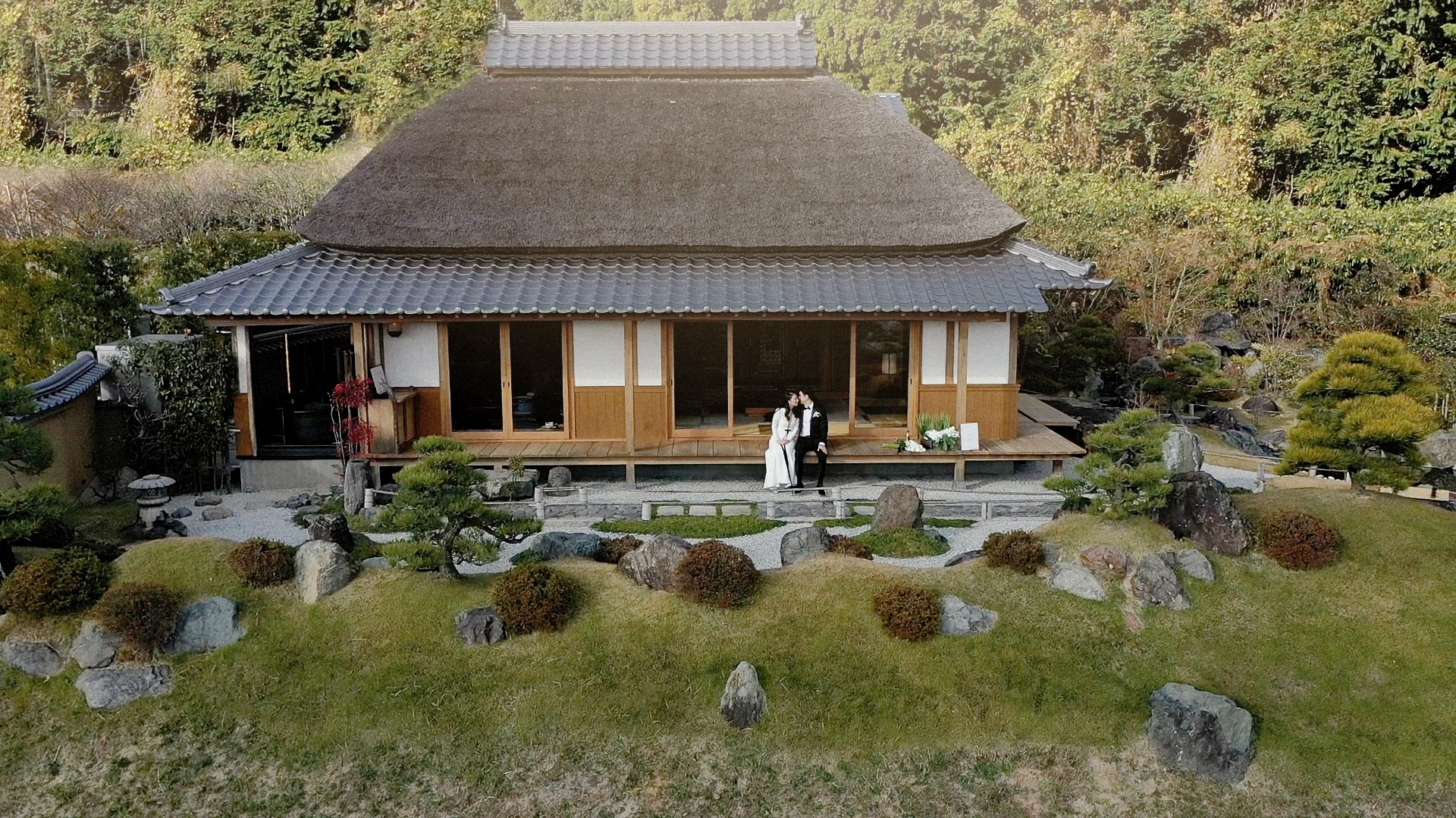
In early 2021, with Japan’s borders still closed, we learned that the owner of Sasayuri-Ann had done something we’d never have thought to do. He had entered our film of an elopement at his villa, in the mountains of Nara, in the Japan World’s Tourism Film Festival. Out of more than 1,200 films entered from around the world, it became a finalist in the festival’s International Competition.
The festival is Japan’s first international tourism film festival, and part of CIFFT, the network of tourism film festivals recognised by UN Tourism, the United Nations’ tourism agency. In 2021 it was held at Kiyomizu-dera, the great wooden temple on the hillside above Kyoto, a World Heritage site whose stage, raised over the slope on tall wooden pillars, is one of the most recognised sights in Japan. With the borders closed, it was streamed to the world from the temple, awards and all, along with a Buddhist service praying for dialogue and understanding in the world and an early end to the pandemic.
Made for Two People
The other finalists included what you’d expect at a tourism festival: films from tourism boards and production studios, made for islands, hot spring towns and whole regions around the world. Beautiful work, made to bring people to a place.
Ours was made for two people. In the autumn of 2020, a couple living in Tokyo flew by helicopter from Kyoto to a thatched villa above the rice terraces of Uda. There was a blessing at a waterfall at sunrise, and vows at a round window, with koto and shakuhachi. No one was cast. It was simply their day.

What a Tourism Film Can’t Show
A tourism film shows you a place at its most beautiful. A wedding film shows you what the place can hold: the light at the round window, the first notes of the shakuhachi, two people finding their words. That’s the light of a country too. It’s just harder to schedule.
The truest film of a place is made on a day that matters to someone.
Japan has never needed help being looked at. What a camera rarely catches is the other half of that old line: how a place receives people. A wedding gives it something to catch.

The Host Saw It First
What we treasure most is who entered it. Sasayuri-Ann belongs to a local family who host every couple themselves. Nobody has seen that garden in more seasons than its owner, and he knows its light better than we ever will. He watched our film and decided the world should see it.
Hosts like him live the second half of that old line every day. That he recognised the first half in our film is the kindest review we could have asked for. Thank you, Mr Matsubayashi.
We make films for the couple first, then for the people who couldn’t be there, and one day for the children who’ll want to see how it began. That one of them could stand among the world’s tourism films still surprises us a little. Then we remember what the word means.
The whole day is in Above the Rice Terraces: A Helicopter Elopement in Japan. For more of the villa, there’s An Elopement in the Clouds.