A Tokyo Autumn Elopement, With Their Own Songs on the Koto

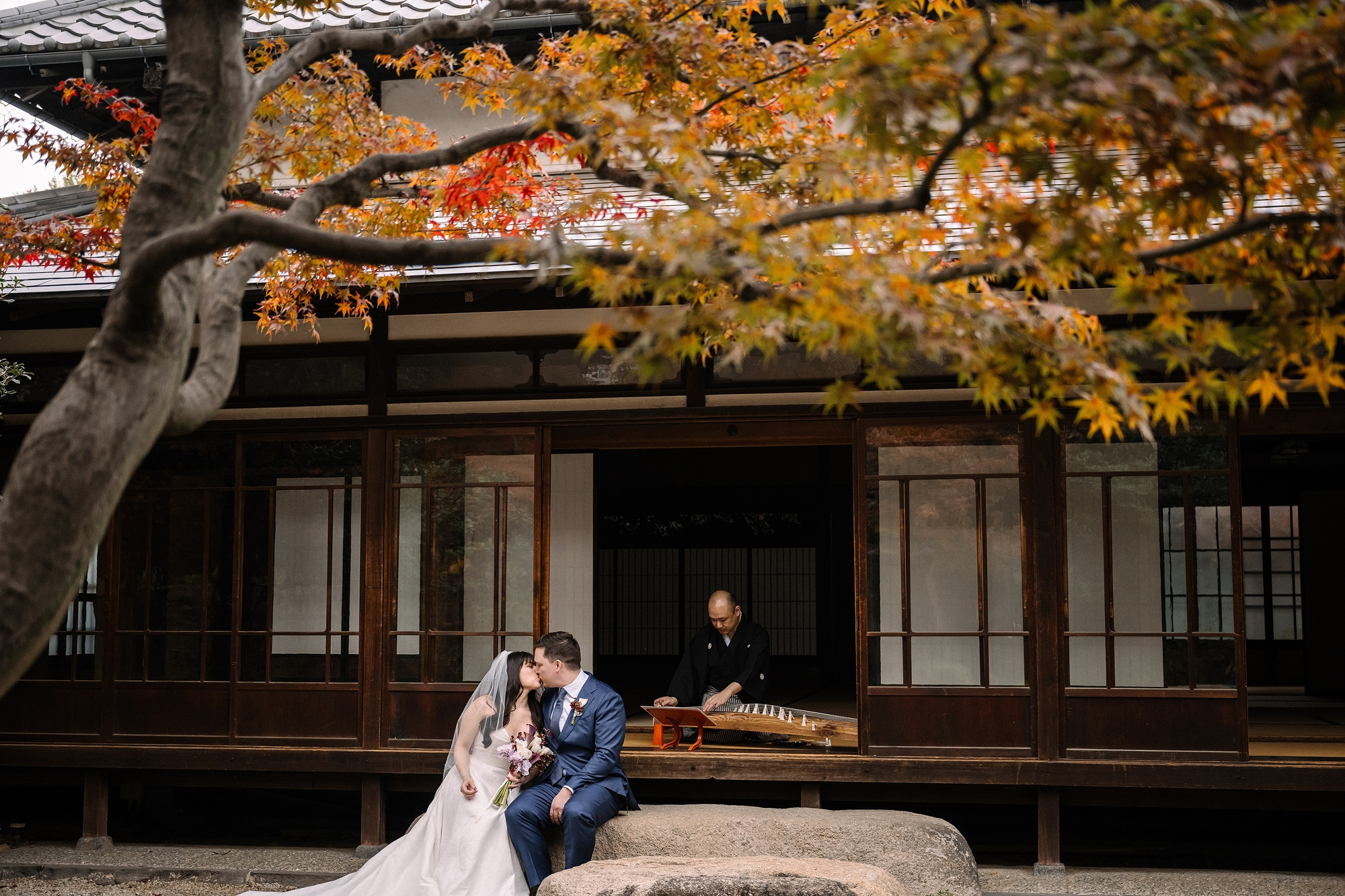
The couple sit together on a garden stone in autumn as a koto player plays on the open veranda of the wooden house.

A koto has thirteen strings, and each one rests on its own movable bridge. To play a different piece, the player slides the bridges along the instrument and it retunes itself around the music. For this Tokyo autumn elopement, a koto player we work with often set his bridges for Beach House and Nina Simone. The songs were a different mood from anything we’d asked of him before. He took them on, and sent a recording ahead so the couple could hear what their music was about to become.

They’re a Texas couple, and theirs was an elopement in the truest sense: the two of them and our team, in a private garden in Tokyo at the turn of December. Private people by their own description, they’d got engaged back home in the place of their first date, and then went looking for the opposite. They wanted to marry “somewhere completely opposite of Texas since marriage is the start of a new adventure for both of us.” Everything about the day was sized to two people and chosen by them. The music was theirs. The cake was the smallest size the baker makes, framboise and pistachio, finished in white with deep bordeaux flowers matched to her bouquet, and an iced cookie of their pug beside it. It takes a particular clarity to cross the Pacific for a day nobody else will attend, and then fill it with things only the two of you would recognise. We loved them for that clarity from their very first message.

A wooden gate opens onto a Japanese garden in Tokyo, with a raked stone path, clipped pines and autumn maples beyond the tiled roof.
A bride in a strapless gown and veil holds white calla lilies and lilac flowers in a Japanese garden in Tokyo in autumn.

We think it’s also the best way to bring a wedding to Japan. The days we’re proudest of don’t trade a couple’s life for a postcard of this country, and they don’t carry home over unchanged either. They translate, the way a koto player translates a song.

Thirteen Strings, Retuned

The koto came to Japan from Tang China in the Nara period and was first played in gagaku, the music of the imperial court. Its strings run the length of a body made of paulownia wood, and the bridges, called ji, are what make it so open. Move them and the same thirteen strings can hold a different scale, a different century, a different country.

On 27 November 1920, at the Yurakuza theatre in Tokyo, the koto master Miyagi Michio, blind since childhood, gave a concert of new work with the composer Motoori Nagayo. The shakuhachi player Yoshida Seifu billed it as a great concert of shin nihon ongaku, new Japanese music, and the name stuck to a whole movement: bringing the harmonies and forms of Western music into the koto’s world. Miyagi later spent the second half of his life in Shinjuku, where his memorial hall became the first in Japan built for a musician. The private house where this couple married was finished in that same year, 1920. A century on, the instrument was still doing what Miyagi asked of it: meeting music from somewhere else and making room for it.

A koto player in a black hakama leans over the long wooden instrument on a tatami floor in a traditional Japanese house.
A koto player in a black hakama smiles with his palms pressed together, kneeling on tatami in a room of paper screens.
The couple stand beneath a great red maple in front of a traditional Japanese house in Tokyo at the peak of autumn colour.

Their songs asked a lot of it. Beach House, the dream-pop duo from Baltimore, carried her into the garden with “Space Song”. After the vows, their “PPP” played on through the kiss and the walk back out. During the portraits came “Who Knows Where the Time Goes”, the song the English singer Sandy Denny wrote in the late 1960s, which Nina Simone made her own on a live record released in 1970. It had already crossed one ocean and one tradition before it reached thirteen strings in a Tokyo garden: a song about time, on an instrument that has been in Japan for some thirteen centuries, beside a house a hundred years old.

A Garden With No Audience

With no guests, there were no speeches. The only words of the day were the ones they’d written for each other, and they read them to each other in the garden, with nobody waiting on the other side of a door. We’ve written before about what an elopement actually is, and this was the clearest form of it: two people, a place that asked nothing of them, and all the time they wanted. They kept one Japanese ritual inside it, san-san-kudo, sipping in turn from red lacquer cups the way couples here have sealed a marriage for generations.

A groom waits on a raked gravel path in a Tokyo garden as the bride walks towards him beneath trees in autumn colour.
The groom wipes his eyes as the bride reads to him from a small book, with orange maple leaves behind them in a garden.
The bride reads aloud from a small white book in a Japanese garden, her veil over her shoulders and maples glowing behind.
The groom reads from a small book in a navy suit with a dark red flower on his lapel, the bride's veil soft in the foreground.
The couple kiss on a gravel path in a Japanese garden in Tokyo, framed by red and gold maples and clipped pine trees.
  • The bride walks along a garden path from a roofed wooden gate, framed by red maple leaves in the foreground in Tokyo.
  • The groom stands in a navy suit in an autumn garden, one hand at his face, among clipped shrubs and orange maples.
  • The groom turns towards the bride in her veil on a garden path beside an old wooden Japanese house in Tokyo.
  • The groom wipes a tear from his eye in a navy suit and dark red boutonniere, with soft autumn leaves around him.
  • Seen from behind in her long veil, the bride faces the groom as he covers his eyes with one hand in an autumn garden.
  • The bride holds her bouquet as she faces the groom beside the veranda of a traditional house in a Tokyo garden.
  • The couple stand facing each other on a raked gravel path under red maples and pines in a Japanese garden in Tokyo.
  • The bride reads from a small book to the groom in a Japanese garden, with deep red maple leaves above them.
  • The bride reads from a small book with tears in her eyes while the groom wipes his face, with autumn colour behind them.
  • The bride smiles as she reads from a small book, her long veil over dark hair, facing the groom in a Tokyo garden.
  • The couple stand far down a garden path, seen through a dark maple branch hung with a few red and yellow leaves.
  • The couple face each other on raked gravel while a koto player sits on the veranda of the old wooden house behind them.
  • The groom smiles at the bride across a garden, with a koto player on the veranda of the wooden house in the background.
  • The groom sips from a small cup held in both hands in front of the wooden screens of a traditional Japanese house.
  • The groom slides a ring onto the bride's finger as she looks down at her hand, with autumn maples behind them.
  • Bright red momiji leaves fill the frame above a garden in Tokyo, with a soft green tree behind them at peak colour.
  • From inside the house, a koto player plays on the veranda as the couple sit together on the edge of the garden.
  • A dark tatami room opens through wooden doors to an autumn garden, where the couple sit beside the koto player.

The house itself is one of the places we open to couples quietly. It’s an authentic pre-war Japanese house, with tatami rooms, shoji screens and a garden laid out to be walked slowly, the kind of place Tokyo has very few of now. Its name stays with us. When we plan an elopement in Tokyo, this is where we’d want a day like theirs to begin: somewhere with a history, no crowd, and a house that has been doing the same quiet work for a century.

Tokyo’s Maples at Their Peak

Tokyo’s maples are among the last in Japan to turn. The Japan Meteorological Agency’s average date for the city’s maples to colour falls at the very end of November, so the first days of December are when its gardens are often at their deepest. This garden was at its peak on their day. Colour like that can’t be booked. You choose the season, and the place does the rest.

Red and orange momiji leaves hang from a dark branch in a Tokyo garden at peak autumn colour in early December.
The couple stand close beneath a tall red and gold maple in a Japanese garden, the bride holding her bouquet at her side.

They married on the first day of a five-day season that the old calendar calls tachibana hajimete kibamu, the tachibana begins to turn yellow. The tachibana is Japan’s native citrus. Because its leaves never fall, it has long stood for permanence, and it has been planted in palace grounds since the Heian period. So the calendar marks the week when an evergreen’s fruit starts to turn gold, at the very moment the maples are at their fullest. It’s a fitting week to make a promise.

  • The couple sit on a garden stone under a canopy of red and yellow maple leaves in front of a wooden house in Tokyo.
  • The couple stand side by side beneath red maples in a Japanese garden, the bride holding her bouquet of calla lilies.
  • The groom kisses the bride's cheek beneath red and gold maples in a Tokyo garden, a stone path at their feet.
  • The couple walk hand in hand through a Japanese garden in Tokyo, with pine trees and maples in autumn colour behind them.
  • The couple smile as they walk among pines and red maples in a garden, the bride in her veil with her bouquet.
  • The bride looks up and laughs as she walks hand in hand with the groom in a Japanese garden in autumn colour.
  • The couple stand on a raked gravel path in a wide Japanese garden in Tokyo, ringed by clipped shrubs and autumn trees.
  • A bride holds a bouquet of white and deep plum calla lilies with lilac flowers against the skirt of her white gown.
  • The bride gazes up in her veil holding her bouquet, with the groom's shoulder soft in the foreground in a Tokyo garden.
  • The dark timber posts of a garden gate frame the couple standing among autumn maples in a Japanese garden in Tokyo.
  • The couple walk hand in hand through a wooden garden gate, with orange and red maples on the path behind them.
  • The couple stand beside the veranda of an old wooden Japanese house, beneath the spreading branches of an orange maple.
  • The groom holds the bride close among green and gold leaves in a Japanese garden, her veil and bouquet in soft light.
  • Blurred red maple leaves frame the couple standing together in a Japanese garden in Tokyo in late autumn.
  • The groom holds the bride from behind among autumn shrubs and maples in a Japanese garden, both smiling at the camera.
  • A close view of red and orange maple leaves lit from behind, at the peak of autumn colour in a Tokyo garden.
  • In black and white, the groom lifts the bride's long train as they walk away through a garden gate in Tokyo.
  • A single maple tree in full red colour stands among moss and stones in a Japanese garden in Tokyo in early December.

We like to leave a pause in a day for two, a stretch with nothing scheduled. Theirs was in the tatami rooms: light food, the cake, and an hour to be married without anyone needing anything from them. An elopement can easily turn into a photo shoot with vows in the middle. The pause is what keeps it a wedding.

A small white wedding cake with painted deep red flowers and an iced pug cookie sits on a round wooden board on red.
The couple cut a small white wedding cake together at a red lacquer table, with lilac flowers beside it in a tatami room.
The bride stands in silhouette in a dark tatami room, her long train spread across the mats towards bright garden doors.
The groom leans his head against the bride's as she smiles with her eyes lowered, beside a window in a Japanese house.
The couple stand together in an open doorway of a traditional Japanese house, backlit by the garden beyond the screens.
  • The couple sit at a red lacquer table in a bright tatami room as the koto player in black hakama stands beside them.
  • The couple talk with the koto player in black hakama across a low red table in a tatami room lined with glass windows.
  • Two round glass lamps hang from a carved wooden fixture against a gold wall in a traditional Japanese house in Tokyo.
  • The bride's long train spreads across the tatami as she stands with the groom in a bright doorway at the end of the room.
  • In black and white, the couple stand apart by tall glass doors in a traditional house, her train trailing on the floor.
  • In black and white, the bride and groom stand in a doorway at the end of a tatami room, framed by paper screens.
  • In black and white, the groom kisses the bride's forehead as she leans into him, his white flower bright against the dark.
  • The couple are seen through a glass reflection of green and orange leaves, layered over the bride's white gown.
  • The bride walks down a long wooden corridor of a traditional Japanese house, lanterns overhead and glass doors on one side.
  • The couple stand at the far end of a dark wooden corridor in an old Japanese house, lit by the windows beside them.
  • In black and white, the bride looks towards window light while the groom rests his face against her hair.
  • The groom's hand holds the bride's arm against the textured fabric of her white gown in a soft close detail.
  • The couple embrace in a narrow wooden corridor of a traditional Japanese house, a paper lantern hanging above them.
  • Red maple leaves frame a traditional wooden house in Tokyo, where the bride stands on the veranda in her white gown.
  • The couple stand together by the glass doors of a wooden corridor, the bride looking out and the groom close beside her.
  • The couple stand in a wooden corridor, framed by a blurred timber post at the edge of the picture in a Japanese house.
  • The couple smile at each other beside dark wooden doors in a traditional Japanese house, their reflection beside them.
  • In black and white, the couple cross a tatami room beneath hanging lamps, with garden light through the windows.

Kabukicho, Named for a Theatre That Never Came

Their day had begun high above Kabukicho, at a hotel window facing the towers of Nishi-Shinjuku, and the city is where it ended up too.

  • Two wedding rings and a diamond engagement ring rest on a black reflective surface with soft silver light around them.
  • The skyscrapers of Nishi-Shinjuku in Tokyo seen from a high hotel window, with towers of glass and steel side by side.
  • Two wedding bands stand together inside a curved glass reflection on a black surface, with a small diamond line on one.
  • The groom writes in a small notebook at a desk in a T-shirt on the morning of his elopement in Tokyo.
  • A small white book marked vows sits on a wooden table with the rings, earrings and a pair of white wedding heels.
  • In black and white, shafts of light fall over the Tokyo skyline seen from high above, with towers and streets below.
  • A white wedding dress hangs in a high window over Shinjuku while the bride stands nearby in a white robe.
  • A navy suit hangs in an empty tatami room with paper doors and glass lamps, ready in a traditional Japanese house.
  • The bride touches her earring in a mirror beside a bright window, her dark hair falling over one shoulder.
  • The groom reaches for his navy jacket hanging on a wooden frame beneath glass lamps in a traditional Japanese house.
  • The bride holds the edge of her veil by a window in soft light, wearing a strapless gown on the morning of her elopement.
  • The groom straightens his tie by the wooden glass doors of a Japanese house, with yellow leaves soft in front of him.
  • The bride's face is softened behind her veil, the sweetheart neckline of her strapless gown sharp in the light.
  • The bride stands in her strapless gown and veil against a pale blue wall by a window, her long train spread on the floor.
  • The groom sits inside a traditional house, seen through tall wooden doors and glass panes before the ceremony in Tokyo.
  • A weathered stone lantern stands among moss and green shrubs in a Japanese garden in Tokyo on an autumn morning.

The neighbourhood’s name dates from 1948. As Tokyo rebuilt after the war, the area was planned around a new kabuki theatre, and it was renamed in anticipation. The theatre was never built. From the 1950s, cinemas and playhouses went up one after another instead. One of them, the Shinjuku Milano-za cinema, closed at the end of 2014, and a new tower now stands on its site, with a theatre inside that still keeps the Milano-za name.

A few streets away, the life-size Godzilla head that looks down over Kabukicho’s streets sits on the eighth-floor terrace of the Shinjuku Toho Building, which opened in 2015 on the site of the old Shinjuku Koma Theatre. Walk Kabukicho with that in mind and it reads differently. The district that never got its kabuki theatre has been building and rebuilding stages ever since, and the newest ones stand on the footprints of the old.

So Kabukicho is a neighbourhood named after a promise it didn’t keep, which went on to become something livelier on its own terms. For two people whose day had been planned to the song, it was the right place to finish: the part of Tokyo that has always made its own plans. As the light went, they crossed Shinjuku the way people who live here do, through the big crossings, under the lanterns of Omoide Yokocho, and out beneath the red gate of Kabukicho Ichibangai.

The life-size Godzilla head looks out over a Kabukicho street in Shinjuku above the Hotel Gracery and Toho Cinemas signs.
The couple walk hand in hand across a wide zebra crossing in Shinjuku, with signs, shops and crowds behind them.
The red neon gate of Kabukicho Ichibangai glows over a busy street in Shinjuku at night, lit by bright signs on both sides.
The couple walk beneath paper lanterns and autumn decorations at the entrance to Omoide Yokocho in Shinjuku at dusk.
The couple dance past giant letters spelling TOKYO inside a glass building at night, her long coat swinging.
  • The sun sets over a Shinjuku road, with blue overhead signs and towers silhouetted against a pale evening sky.
  • The bride leans her head on the groom's shoulder on a zebra crossing in Shinjuku, with a black taxi behind them.
  • The couple walk away up a busy Kabukicho street in Shinjuku, the signs and buildings blurred on either side of them.
  • The couple walk hand in hand up a crowded street in Kabukicho, with Hotel Gracery and its signs at the end of the road.
  • The couple cross a busy Shinjuku street among crowds of people, with tall pine trees and signs beside the crossing.
  • The couple stand together in the middle of a Kabukicho crossing, smiling, as people walk past them on every side.
  • The bride laughs and looks at the groom as they walk hand in hand past blurred neon signs in Shinjuku.
  • The couple walk through an evening crowd in Shinjuku, smiling, with colourful neon signs blurred behind them.
  • The couple walk across a wide zebra crossing in Shinjuku beneath giant billboards, with people moving all around.
  • The bride looks back over her shoulder as she walks hand in hand with the groom across a busy crossing in Shinjuku.
  • In black and white, the couple walk with crowds across a Shinjuku crossing, with tall buildings and signs behind.
  • A tall illuminated sign framed by red paper lanterns rises over a Shinjuku street against a blue evening sky.
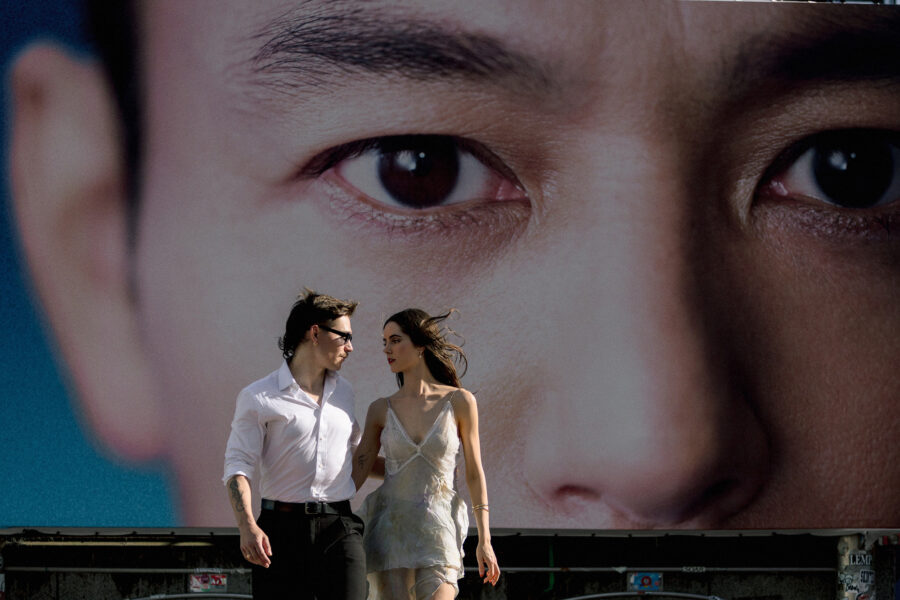
  • The couple stand on a Shinjuku corner beneath a curved billboard showing a giant cat on top of a busy building.
  • The couple walk out of a narrow lane under glowing paper lanterns and red autumn leaves in Omoide Yokocho, Shinjuku.
  • The couple stand at the mouth of a narrow alley beneath lanterns and strings of lights in Omoide Yokocho, Shinjuku.
  • The couple laugh together beneath red leaves and white lanterns in Omoide Yokocho, Shinjuku, as evening falls.
  • In black and white, the couple walk arm in arm down a narrow lane of small bars and hanging signs in Shinjuku.
  • In black and white, the couple pass giant letters spelling TOKYO inside a glass building at night in the city.
  • The bride smiles over her shoulder beside the groom with Tokyo's night lights blurred into colour behind them.
  • In black and white, the bride smiles at the camera beside the groom with city lights soft behind them in Tokyo.
  • In black and white, the bride leans into the groom and smiles with her hair falling forward against the city lights.

We think of this part of an elopement as the day’s second half, and a necessary one. The garden held the vows. The city let them be a married couple in public for the first time, in a place where nobody knew them and everyone was going somewhere. Our photography is built to keep both halves, the quiet and the noise, because a marriage is lived in both. They’d asked for exactly that from the start: “the combination of the big city and the nature landscape.”

What the Time Was For

The song they chose for the portraits is a question. This couple came close to answering it. Their time went into a garden at the peak of its year, the songs they love retuned for thirteen strings, a pug in icing, and a neighbourhood that never became what it was named for. When their album reached Texas the following spring, they wrote that it was “perfect and more beautiful than we could have imagined.”

We’ll always argue for an elopement that is unmistakably the couple’s own, in a place that is unmistakably itself. Japan doesn’t ask you to leave your life at the door. It moves its bridges and plays your song.

In black and white, Tokyo spreads to the horizon at night seen from high above, with a lit window at the edge of the frame.