The fog that morning in Hakone was the thickest we’ve ever seen. White in every direction, so dense you could barely see a few centimetres in front of you. Somewhere behind it stood Mt Fuji, the view nearly every Hakone proposal is planned around, and the one this proposal had been planned for.
We were worried. He wasn’t. He was ready to propose that day, and nothing was going to stop him.

They came from the US. He found us in January through our engagement galleries, and a spring cancellation opened the date, the first piece of luck in a plan that needed several. His problem was a happy one: she notices things. In his words she was “already onto my trail!”, so the word photoshoot could never be said out loud, and the whole morning had to arrive disguised as something else. We liked them both at once for it. She was too sharp to fool easily, and he was determined to try anyway.
A Sunrise Van and a Tour Guide
What she was told was true, as far as it went. He’d booked a private van for sunrise sightseeing, out before public transport starts running, when the roads over the Hakone hills are still empty. The van was ours, and so was the tour guide. We played that part all the way up to the rim of the caldera, a guide with a camera and a perfectly ordinary reason to be carrying one.
Planning like this is a particular pleasure. One person has to know everything and the other nothing, and the plan has to hold up in front of someone who notices things. The whole point of that planning is simple. It carries every moving part, so the person proposing only has to carry the ring.
Turn Around: A Hakone Proposal in the White
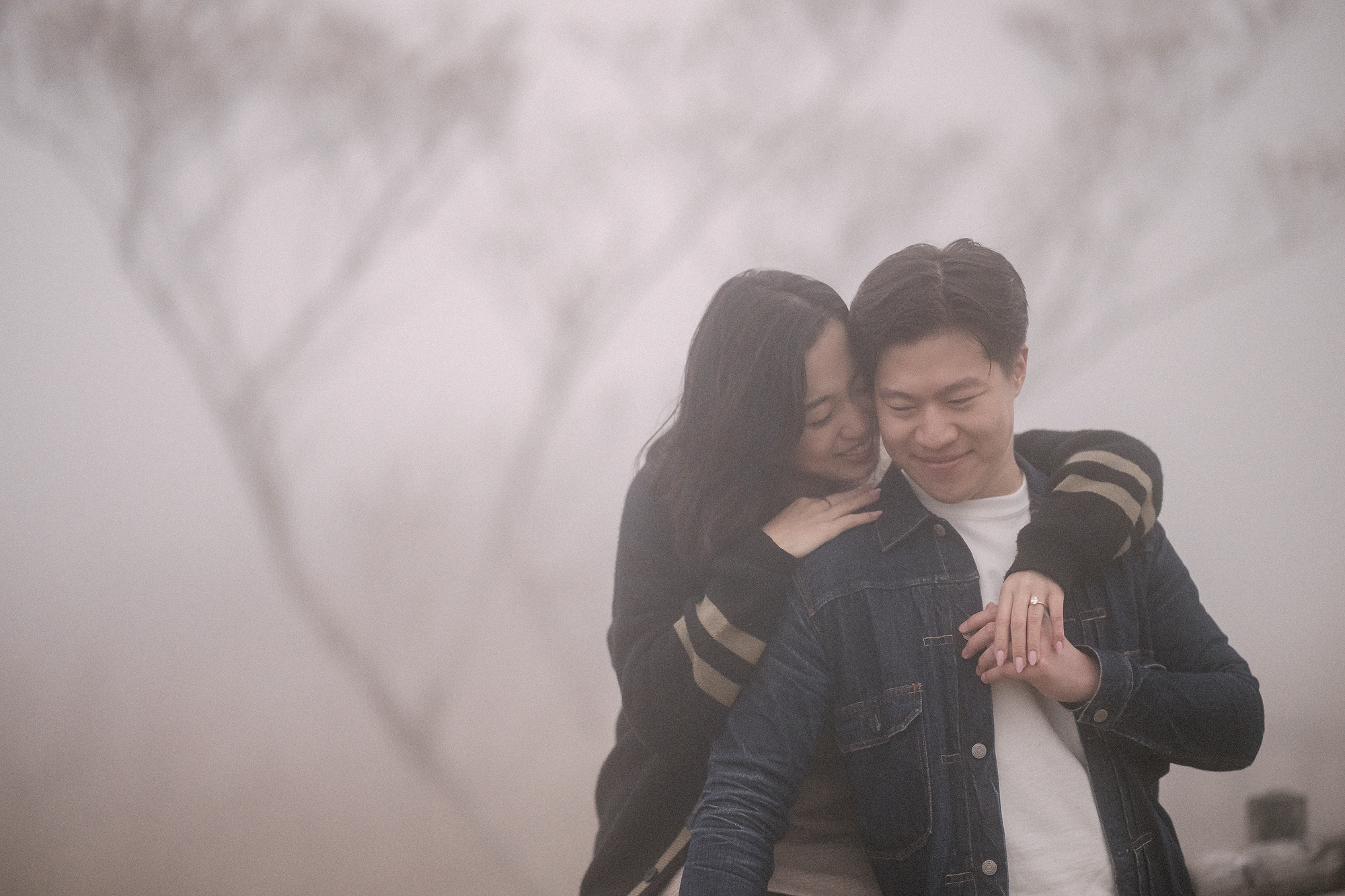
On the green beside the Taikanzan observation area, where on a clear morning Fuji sits across the valley, there was nothing to see at all. The guide offered a photo. The two of them faced where the view should have been, then looked out in different directions, which gave him the seconds he needed to ready the ring. Then came the one line in the whole plan that mattered: she was asked to turn around.
He asked her in the middle of the white, with the trees behind them reduced to dark, soft silhouettes. It was nothing like the proposal he had pictured. It turned out to be beautiful, and Hakone in the mist like that is one of the most striking things we’ve ever photographed there.
He told us afterwards that the choreography made his life much easier. That’s exactly what it’s for. A proposal asks the person proposing to hold the question and his nerves at the same time, and the less he has to manage, the more of the moment he gets to live. Every step was there so that when she turned, he was ready, and nothing else needed him.
Fog has a way of shrinking the world to whatever is close: a few trunks, the blossom nearest the path, the person in front of you. There’s a Japanese word for the depth that lives in what’s half hidden, yūgen, and that morning had plenty of it. We’d never wish the mountain away. But a proposal is the one moment in a relationship that wants the world small, and Hakone gave them exactly that. They called it “such a unique morning with the mist and cherry blossoms”, and they adored it.

The Checkpoint That Read Faces
Later in the morning they came down to the Hakone Checkpoint on the shore of Lake Ashi, the fog still holding the old road. The shogunate set the checkpoint on this site around 1619, one of the largest guarding the roads into Edo, and for about two and a half centuries it decided who crossed the mountain. Its notice board still carries the rules issued in 1711, and the first is plain: every traveller removes hat and hood so the officials can see their face. Women leaving Edo were checked hardest of all, by a woman inspector, the hitomi-onna, who compared each traveller’s features, down to her hair, against the description in her papers.
The gates they walked beneath were rebuilt from a detailed record of a late Edo repair, with the tools and techniques of the time. It’s a place that spent centuries reading faces, and photography is a kinder version of the same work. “You really weren’t kidding when you said you captured the surprise on camera,” he wrote when the photographs arrived, and the two of them flicked back and forth between the frames of her face realising what was happening. A checkpoint reads a face to decide whether someone may pass. A photograph keeps the second a face changes, so it can be read again for the rest of their lives.


Dark Beneath the Cedars
Japan has been singing about this weather for more than a century. In 1901 Taki Rentarō set Torii Makoto’s poem Hakone Hachiri to music for the country’s middle schools, and its picture of the mountain road is the one they walked into: clouds circling the peaks, mist shutting in the valleys, and the cedar avenue dark even at noon. A clear day would have given them the view everyone comes for. The fog gave them the Hakone of the song instead, older and quieter, and for one morning almost private.


It Was Perfect
His verdict needed three words: “It was perfect.” The photographs, he wrote, were “so much better than anything we could have dreamed of”. We treasure notes like that. The line we’ve kept closest came later, when they wrote that we’d become “such an integral part of our story”, and that they hoped our paths would cross again whenever they’re in Japan, or for “any future big chapters of our lives”.
He came to Hakone for a view of Fuji and asked his question inside a cloud. A proposal lasts a few seconds, and everything we build around it, the van, the guide, the turn, exists so those seconds can be lived instead of managed. Fuji can keep its own hours. The face was what they came for, and the fog only brought it closer.