Momiji, the Japanese word for autumn leaves, grew out of an old verb, momizu: to turn red, to turn yellow. The word was a season’s action long before it became the everyday name for a maple. We think that’s the right way to understand an autumn wedding in Japan. You don’t book a view and wait for it to hold still. You arrive while a mountain is in the middle of changing, and you let it change around you.
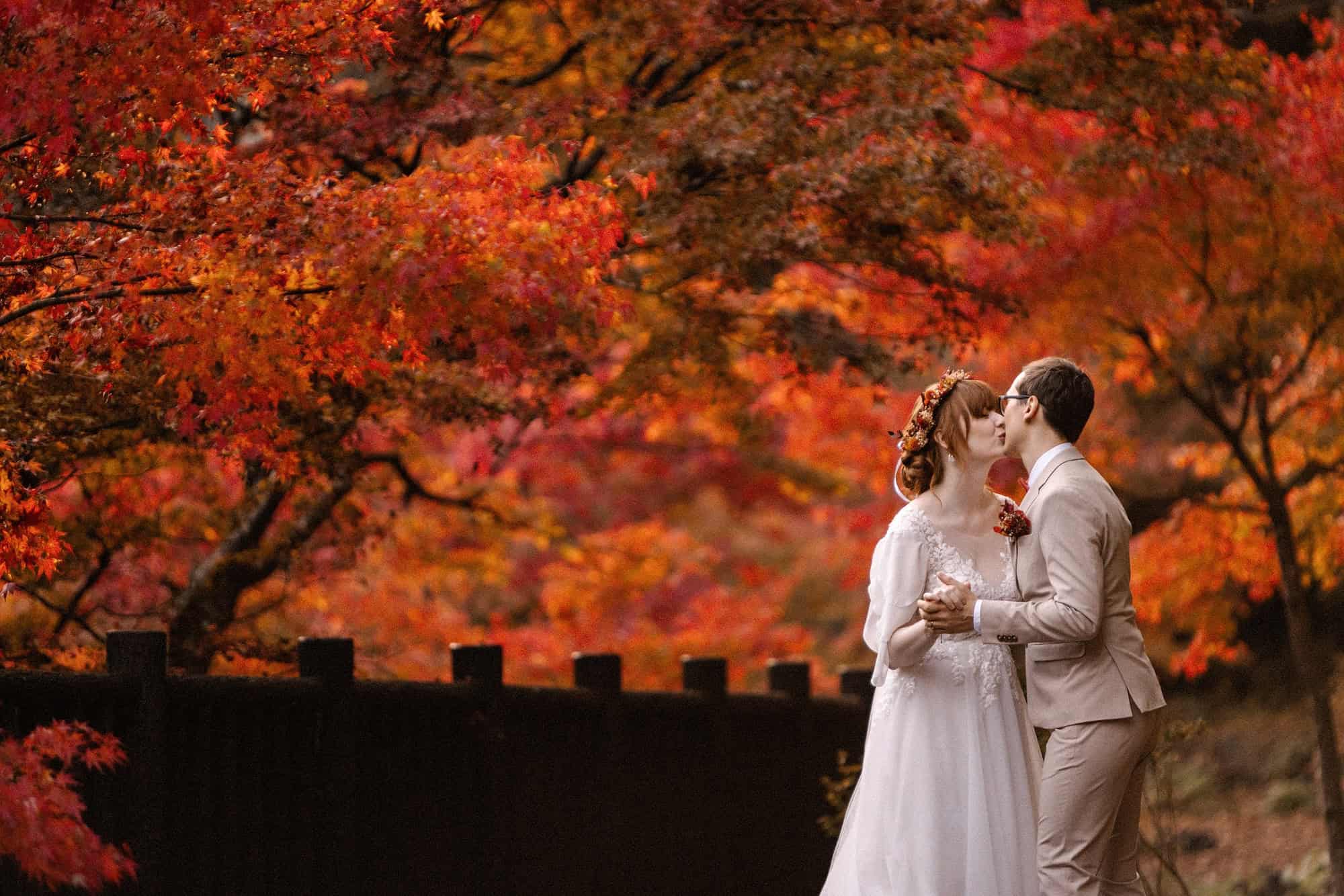
This couple married in the third week of November in Kosuge, a village of about six hundred people in the northeast of Yamanashi, with the maples at full colour. They came dressed for it. Her veil trailed leaves in rust, red and gold, a maple or two among them, and the flowers in her hair and in her hands were dried ones in the same palette. His bow tie matched the hillside. They didn’t bring a colour scheme to the mountains and hold it up against them. They borrowed the mountains’ own.
They weren’t coming to Japan for the first time. In 2022 they lived in Kōfu, the capital of Yamanashi, and the lakes beneath Mt Fuji had become part of their shared geography. By the time they began planning from Switzerland, he a software engineer and she a designer, marrying in Japan felt less like choosing a destination than going back to somewhere that already mattered. They asked for autumn in their very first email. When we proposed NIPPONIA Kosuge they fell for it quickly, and when the dates moved to the middle of November they welcomed it: later meant a better chance of meeting the mountains at the height of their colour. They took the old house for three nights, so they could arrive, settle and feel at home in it before the day itself. We loved that the season was their idea before it was ours.
Their film opens at first light, on mist lying in the valleys while the sun finds the ridges above the village. It keeps what a photograph can only point towards: the river moving, the leaves moving, and a small group of people drawing closer in a garden as the day went down into evening.
Never the Same Wedding Twice
Every wedding and elopement we’ve had at NIPPONIA has been completely its own. Each couple makes the place theirs, and we never tire of seeing how different each one turns out to be: a different season, different people, different cultures, different light and weather, different words and different ways of celebrating. An October wedding at NIPPONIA Kosuge was a world of its own. This one, dressed in red and gold, was another. We plan for couples from so many countries, in so many languages, and some days it still stops us to realise how lucky we are that all of these people have crossed our path. It’s a diverse and incredible world, and an old house in a mountain village keeps showing us a new corner of it.
Season is one of the biggest of those differences, and we’d like every couple weighing up the best time of year to marry in Japan to sit with it for a moment. Kosuge climbs from the surface of Lake Okutama, at 530 metres, to the ridges of the Daibosatsu range at 2,000, and a village with that much height in it doesn’t live in one season at a time. The tea masters had a phrase for that kind of attention, ichi-go ichi-e, one time, one meeting: this gathering, in this light, won’t come round again. In the mountains, choosing a date is choosing which village you’ll marry in.
That’s the part of the work we hold for our couples when we plan a wedding in Japan, so they never have to carry it: the altitude, the forecast, which valley keeps its light longest, what a place will look like on one particular Sunday in November. When it’s done well, all anyone notices on the day is that everything seems to be in the right place.


Dressed for the Season
A thousand years ago, dressing for the season was a discipline at the Japanese court. From the Heian period on, the colours a courtier wore, outer cloth against lining and robe layered over robe, were set by the time of year, and each combination had its own name. One of them was momiji-gasane, the autumn-leaf layering. For a woman’s five robes it ran from yellow on the outside, through shades of golden yellow and red, to a deep sappanwood red beneath, and the dictionaries find it already in a tale written in the late tenth century.


Her veil was a momiji-gasane of its own. Leaves ran down the tulle in the colours of the hillside outside, with a thin vine trailing through them, and in the dark timber rooms of the old house at NIPPONIA Kosuge it carried the season indoors. She made it with the people closest to her, the way they made every detail of the day together, so that everything the guests saw had been shaped by hands that were in the room. A veil like that is a decision made months ahead, a promise to a season nobody can guarantee. Kosuge kept its side of it.


We love couples who plan this way. Choosing a palette from a place, rather than bringing one to it, takes patience and a certain humility, and it’s the same instinct that makes a wedding feel as if it could only have happened where it did. It’s the instinct we trust most behind the camera too: work with the light a place already has, and wait for the people in it.


Revealed and Made: The Colours of an Autumn Wedding in Japan
Below the village, the Kosuge River runs through a gorge of rock and hardwood forest, and in mid-November its slopes held the whole range of autumn at once: gold, rust, brown and the last of the green. The colour in a place like this has a reason behind it, and it’s one of our favourite pieces of science.


Yellow leaves aren’t made in autumn. The yellow is in the leaf all summer, hidden under the stronger green, and when the chlorophyll breaks down in the cold, a colour that was always there finally shows. Red is different. Red is made. As autumn comes on, the leaf seals itself off from the branch, sugars are trapped inside it, and from them the tree builds a new red pigment. More sugar and stronger sun make a deeper red.


The beeches and oaks that fill Kosuge’s older forests take a third road, to brown, as colourless compounds in the leaf darken with age, and it’s the early browns, still mixed with yellow, that give a slope like this its depth. Japan’s encyclopaedias name the conditions plainly: a wide swing between warm days and cold nights, some moisture in the air, and strong light. That’s why the country’s finest autumn colour so often follows a mountain stream through a valley, and why a gorge like this one is where we go looking for it.
We think about those two kinds of colour a great deal. Some of what a wedding day shows is revealed: what two people already are to each other, visible at last because everything else has been cleared out of the frame. Some of it is made, slowly, out of cold nights and bright days lived side by side. A wedding day shows the first. A marriage makes the second.

Momijigari, With a Wedding Inside It
Going out to look at autumn leaves has a name in Japanese, momijigari, and a long history. Viewing the red and yellow leaves is recorded in writing as far back as the Man’yōshū, Japan’s oldest collection of poetry. For centuries it was a pastime of the court and the nobility. Only in the Edo period did it spread to everyone, when Ueno, and temples in Asakusa and Shinagawa, became Edo’s famous places for maples.


An autumn wedding in Japan’s mountains is a momijigari with a wedding inside it. The small group of people who came up into Kosuge with them received the season as fully as the couple did: a ceremony in the garden with the leaves at their fullest, a long table indoors as the evening came on, and dancing after dark under strings of lights by the lattice front of the old house. They were the couple’s closest friends, gathered from Switzerland and Germany alongside friends still living in Japan, one of them in Kōfu, and many of them had helped make the day with their own hands.


This is what we believe destination weddings are for. Time is the real luxury in them. Give a group of people a whole day in one valley, with nowhere else they need to be, and they stop being guests at an event. They become a party of travellers who saw the same thing together, and when they remember the leaves, they’ll remember each other.


What a Mountain Asks
A mountain in November doesn’t ask much of the people who come to marry in it. It asks them to arrive on its calendar rather than their own, and to let the day be shaped by what the place is doing. That’s harder than it sounds, and this couple made it look easy. Every choice they made, from the leaves on the veil to the colours in her hair, said the same thing: we came for this place as it is, this week, and nowhere else.
Our photography and film are made for days like that, when the place takes part in the story instead of standing behind it. We’ll always be grateful to the two of them for trusting us with this one. In Kosuge that week, the whole valley was doing what the old word says: turning. It was a very good time to begin.