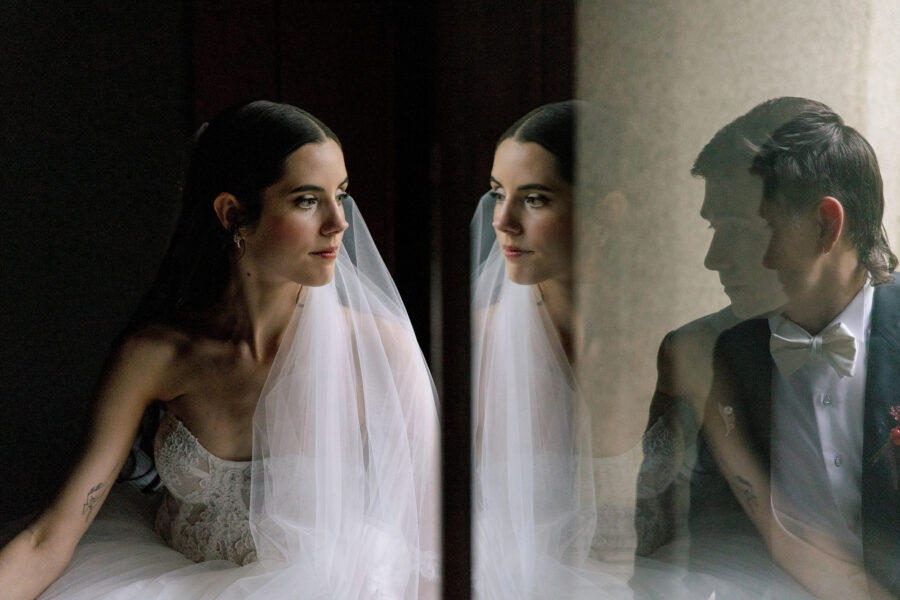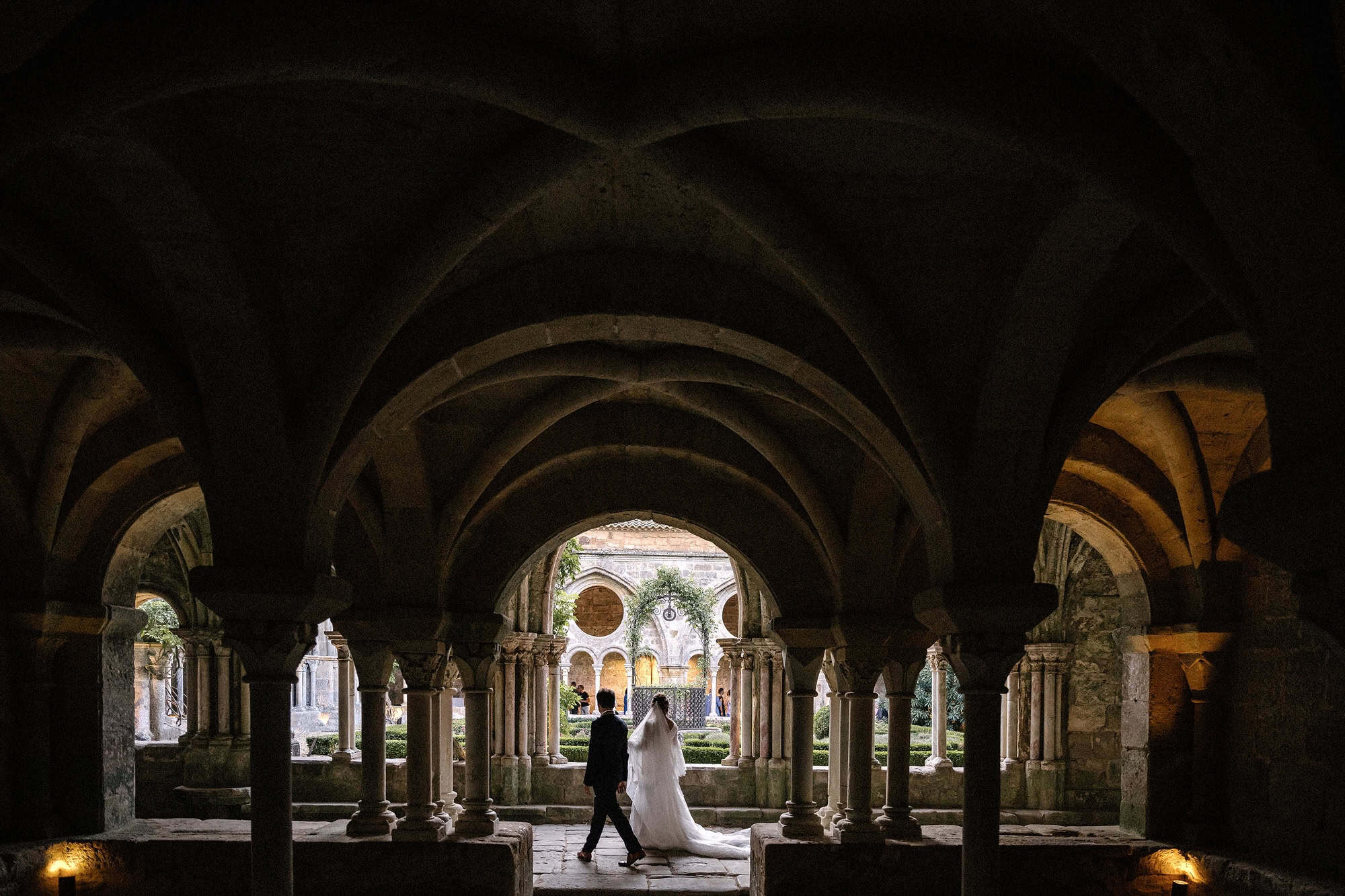
Asking someone to meet you before dawn takes a certain kind of trust. It says the light matters more than the sleep, and that you’d like company for it. This couple asked us exactly that, and three and a half years later the same instinct brought them to an Abbaye de Fontfroide wedding in Narbonne, in the south of France: vows in the Basilique Saint-Paul, one of the oldest churches in the region, then a night at a Cistercian abbey founded in 1093 beside a cold spring in the hills of the Corbières.
They first wrote to us in February 2020, newly engaged and living in Tokyo, after finding our work online, and he soon realised we’d also photographed his friends’ wedding in Bali. Two days after that first email we were on the shore at Enoshima ahead of the sun, because the early hour was his idea. They called that morning “a blast”, and “an amazing, magical moment”.
When they invited us to France, they put it in a sentence we’ve kept: they wanted “this one more special milestone in our life in common with you”. There’s French inside that English, la vie commune, the life two people make together, and it was generous of them to count us in it. Many couples meet us when they come to Japan to marry. These two lived here, and they let us into the years before their wedding as well as the day itself.
The film keeps the day at the pace they lived it, from a quiet house in the morning to a courtyard that didn’t want the night to end. Watching it, they told us, let them feel “all the joy that we lived back then”. It’s why our photography and film are made as one piece of work: some days need to be heard as well as seen.
Enoshima, Tokyo, Kawazu: The Years Before France
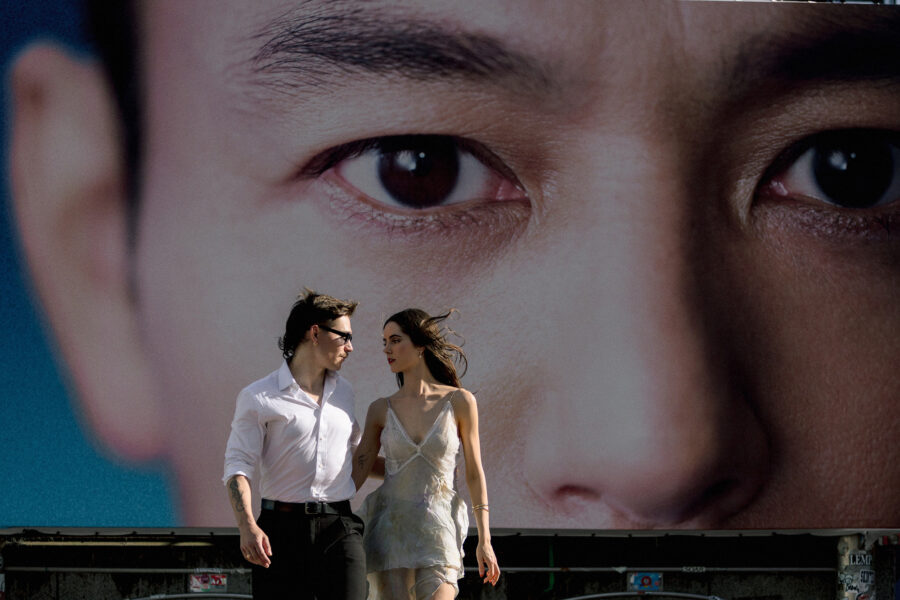
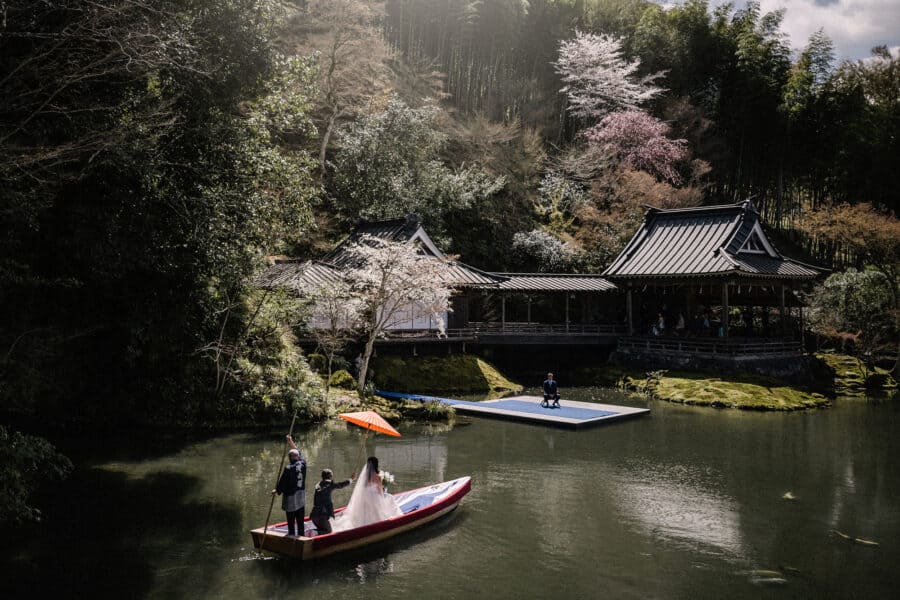
Looking back across their sessions, the pattern is hard to miss. They kept choosing the edges of the day. Enoshima at sunrise in the winter of 2020, with Mt Fuji across the water. Tokyo in late November 2021, a garden in full maple colour and then the roof of Shibuya Sky as Fuji turned to silhouette in the west. The riverbank at Kawazu at first light in March 2022, among the early cherries and last winter’s pale grass.
Kawazu has a beginning story of its own. In 1955 a local man found a single cherry seedling beside the Kawazu River and planted it in his garden. That tree is still cared for, and the early cherry it turned out to be now carries the town’s name and brings hanami to the Izu Peninsula weeks ahead of most of Japan. Standing among those trees at dawn with two people who’d been engaged for two years, it was easy to believe that most of what lasts grows from one small thing, looked after faithfully.
By the time we reached Narbonne, we’d known them through a winter, an autumn and a spring. The wedding didn’t feel like a first meeting with a couple and their families. It felt like the next chapter of something already under way, and that kind of ease can’t be faked on a wedding day.


A Wedding With Everyone
He called it, with a wink, their “revenge wedding”: the day they’d finally get all their family and friends together in one place, from every corner of their lives.
His other promise was that it would be “Hollywood-in-Provence”. The geography was a joke. Narbonne is in Occitanie, closer to the Pyrenees than to Provence, a city the Romans founded in 118 BCE as Narbo Martius, on the Via Domitia, the first road they built through Gaul. The scale was no joke at all. Theirs is a story that runs through Myanmar, France and a shared life in Tokyo, and for one long day the people who love them, from several countries, were in the same place.
That’s the quiet argument for a wedding far from home. It asks people for their time and gives it back with interest: a whole day and night in one place, a basilica by day and an abbey after dark, long enough for two families from different corners of the world to stop being two groups. Nobody is rushing off to the next thing, because there isn’t one.


A Basilica Built Over a Beginning
Paul of Narbonne was the city’s first bishop, one of seven bishops that tradition says Rome sent into Gaul around the year 250. The Basilique Saint-Paul stands on his tomb, and the space beneath it, the city says, was the early Christian cemetery of the third and fourth centuries. The church above was begun in 1180 and given its Gothic choir between 1224 and 1230, the Romanesque and the Gothic, in the city’s own words, “strangely mixed”. Medieval storytellers confused Paul with Sergius Paulus, the Roman proconsul converted by the apostle Paul, which is why Narbonne still calls it Saint-Paul-Serge.
The groom loved that history, and it suits them both. For centuries the basilica was a stop for pilgrims on the road to Santiago de Compostela, a church used to receiving people who’d come a long way. On their wedding day it received family in Myanmar dress and friends from several countries, in a nave that has watched travellers arrive for more than eight hundred years. Look into its white marble holy-water stoup and you’ll find a carved frog, turned to stone, one local legend says, for croaking over the canons’ singing. Sacred places have always kept a little room for a smile.
There’s something right about saying vows over a beginning: a church raised on the tomb of the man who started it all here, for a couple whose own story with us started on a dark shore, waiting for the sun.


Fontfroide, Where Light Is the Architecture
In 1093 a handful of Benedictine monks chose an isolated valley near a cold spring, the fons frigidus that gave Fontfroide its name. Half a century later they joined the Cistercians, and the abbey grew into one of the great houses of the Languedoc: up to 80 monks, 250 lay brothers and nearly 20,000 hectares of land, a daughter abbey at Poblet in Catalonia, and a former abbot, Jacques Fournier, who became Pope Benedict XII.
Fontfroide Abbey describes itself in a line we can’t improve on: in a Cistercian abbey, light isn’t decoration, it’s structure. The early Cistercians wrote that into their rules in the twelfth century, asking for windows of clear glass with no colour and no images, so that stone and sun did the work. Here the light slides across rose-tinted stone and picks out each arch, so that, as the abbey puts it, every hour of the day becomes something to look at.
The colour came later. The last monks left in 1901, and in 1908 the artist and collector Gustave Fayet bought the abbey, restored it and opened it to artists. With the artist Richard Burgsthal he began new windows for the abbey church, and in 1912 he financed a glassworks for Burgsthal to make them. So the church holds two ideas of light at once, the monks’ plain one and an artist’s coloured one, and it has never had to choose. It’s a fitting place for a couple whose life holds more than one culture without asking either to give way. We’d followed these two through a sunrise, a sunset and another sunrise. It seems only right that they married somewhere built to take the light seriously.


Fontfroide’s vines are almost as old as its walls. The monks were working vineyards across the Corbières by the twelfth century, and by the fourteenth the abbey’s sweet wine was poured at the papal table in Avignon. The estate says the names of the plots, the way they face the sun and the dry-stone walls between them still carry the monks’ work. Walking the road out through those vines in the late light, you understand what Fontfroide really offers: the sense that care, kept up long enough, becomes a landscape.


The abbey opens to very few private weddings, which makes an Abbaye de Fontfroide wedding closer to an invitation than a booking. Among the best-preserved Cistercian abbeys in Europe by its own account, it asks very little of a couple except that they slow down to its pace.


A Thousand Years, Then Dancing
Cistercian life was built on silence, and Fontfroide still speaks of the “inhabited silence” of the place. We doubt its walls minded the night of the wedding. Buildings this old have outlasted the Black Death, a revolution and an exile. A courtyard full of guests dancing for two of their own is among the gentler things they’ve held.
That’s the part of a destination wedding no plan can write: the hour when a family from one side of the world and friends from the other forget which side they came from. In Narbonne it happened under strings of lights in the abbey courtyard, and it went on long past the point where anyone was counting.


The best weddings we’re part of rarely begin on the wedding day. This one began on a winter shore in Japan, with a couple who wanted the sunrise and wanted company for it. Three and a half years later, they ended a long day in an abbey made of light and stone, surrounded by everyone they’d hoped to bring. Being asked to keep them company, all the way from Enoshima to Fontfroide, is something we don’t take lightly.