Ask anyone how to photograph Mt Fuji and the answer comes back as a time: early. Go before the day warms, before cloud gathers round the summit, while the lakes are still and the light is cold and clean. It’s sound advice, and it shapes a great many pre-wedding photos in Japan.
This couple asked for the other half of the day. They’re based in Singapore, and they came to us the way good editors come to a shoot: with a Pinterest board, two looks and careful questions about timing, light, outfits and weather. They wanted the afternoon and everything it turns into, from open daylight to golden hour to the blue that comes after, and they wanted to wear two versions of themselves through it. It’s a lovely thing to be handed a plan like that. A couple who argues with the dawn has thought hard about what they want to feel, not only what they want to see.


Choosing the Afternoon
Dawn is the safe choice because it’s a choice about the mountain. The afternoon is a choice about the light, and the mountain is left to make up its own mind. In early May that’s a real risk. The air around the five lakes is turning warm and damp, and as the day goes on it climbs Fuji’s flanks and gathers into cloud.
So the plan was never a single viewpoint. It was a route through the lakes on Fuji’s northern side, with more than one shore in it, so that wherever the cloud chose to sit there was another stretch of water facing a different piece of sky. That’s what planning a shoot at Fuji really is. Nobody can book the mountain. You arrange the afternoon so the light is always worth having and Fuji gets every chance to appear, and it’s the part of planning that never shows in a photograph while sitting underneath all of them.
The afternoon began on the north shore of Lake Kawaguchi, at a favourite spot of ours on the lakeside. That day the mountain kept mostly to its weather, a long dark shoulder under heavy cloud, and the old pines and the pampas grass by the water did the work instead.


Blue, by Way of India
Denim’s blue is indigo, and indigo carries its origin in its name. The word comes to us through Latin from the Greek indikon, the Indian substance: a dye named for the country the ancient world bought it from. In the 1870s a British chemist, Robert William Atkinson, came to Japan and was so taken with the depth of blue he found here that he gave it a name of its own, Japan Blue. The phrase is still in use, most of all among people who love Japanese denim.
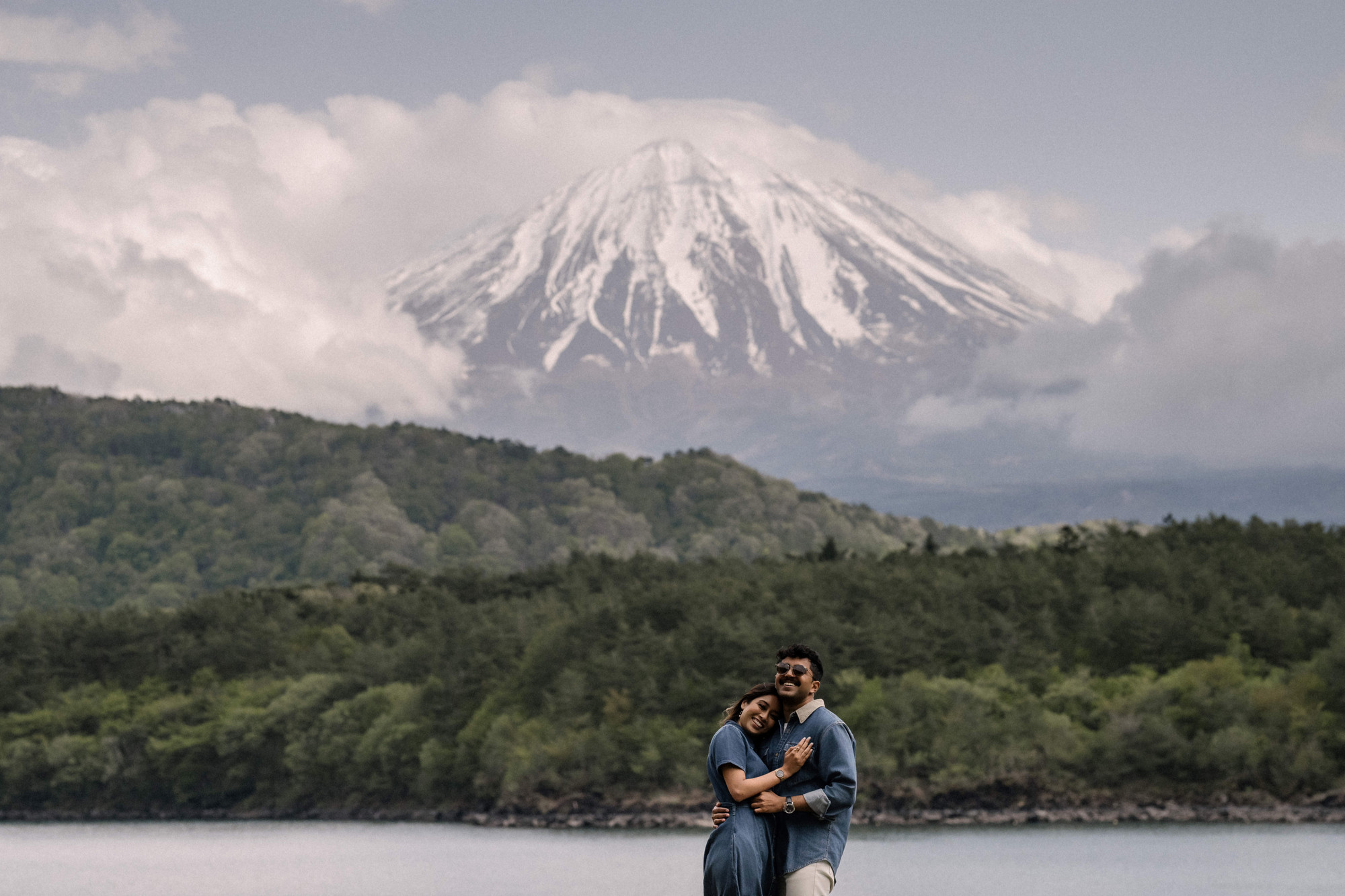
So the first look of the afternoon was a colour named for India, worn in the country that gave it a second name. We doubt they chose it for the etymology. People who plan as carefully as these two choose clothes the way they choose light, for how they’ll sit in a place, and soft blue sits well against grey water, grey cloud and the deep green of old cedars at a shrine near the lake. It’s also what people wear on a free afternoon, and that matters more than it sounds. The first half of the day was spent as themselves.


Lake Saiko, Where Fuji Came Out
Lake Saiko sits just west of Lake Kawaguchi, quieter and deeper in the trees, and the mountain made it. Earlier eruptions had dammed a broad lake called Senoumi on Fuji’s northern side. In 864 the Jōgan eruption poured lava into it and split what remained, leaving Lake Saiko and Lake Shoji where one lake had been, and the forest that runs from Saiko’s southern shore towards the mountain grew over that same lava.
This is where the afternoon paid off. The cloud that had sat on the mountain at Lake Kawaguchi opened over Lake Saiko, and Fuji stood clear, still in its spring snow, above the forest and the water. It’s tempting to say the plan worked. Truthfully, the plan made room. Fuji did the rest.


What Pre-Wedding Photos in Japan Are For
For the last of the light they changed into the dress of ceremony: for her a sage silk saree with an embroidered border, and the jewellery to go with it, and for him an ivory kurta. A saree is a single length of cloth, several metres long, never cut to a pattern or sewn into a shape. It becomes a garment only in the draping, it’s draped again every time it’s worn, and of all the clothes people marry in it may be the one most alive to wind.
Their timing also found the late cherries. The double-flowered yaezakura open after the single blossoms have fallen, and on the slopes above Lake Shoji, around 900 metres up, they were in full flower in the first week of May, long after Tokyo had finished its hanami. It’s a second spring many visitors miss, and a quiet argument for coming to Japan after the calendar says the season is over.
Lake Shoji is the smallest of the Fuji Five Lakes, and it has drawn people from far away for a long time. In 1895 an Englishman, Harry Stewart Whitworth, began introducing it abroad as Japan Shoji, a lake for seeing Fuji. Well over a century later, two people who live in Singapore stood on its shore in a saree and a kurta.
If the denim was the present tense, the saree was the one that comes next. That, to us, is what pre-wedding photos in Japan are for. They give a couple a few unhurried hours to stand inside the future they’re planning, in a country that isn’t home, with no guests, no schedule and nobody waiting for dinner. The wedding will ask a great deal of them. This afternoon asked only that they be there.


When the Light Goes Blue
By the time they were back on the lakeshore at Kawaguchiko, the sky had closed completely, and heavy cloud rolled in over the hills. Golden hour, in the end, was mostly grey. Blue hour made up for it.
This is the part of an afternoon shoot we love most as photographers, and the part a sunrise can’t give you: the ending. A dawn session runs towards ordinary daylight. An afternoon runs the other way, into the dark, and every frame near the end is a little rarer than the one before it. They asked for that ending, and the weather at Fuji delivered it in full theatrical form.


When the photographs went to them, Dee wrote: “You bring the luck!!” We’d put it only slightly differently. They planned an afternoon that would have been worth every hour without the mountain in it. Fuji came out anyway, and we’re still grateful it did.