
A wedding is not a party. It contains a party, sometimes. There is music and food and people who stay longer than they planned. But calling a wedding a party is like calling a novel a book. Technically correct. Entirely insufficient.
What a wedding actually is depends on who you ask. And the answers, when you line them up, reveal something far more interesting than any mood board ever could.
A Public Declaration of Vulnerability
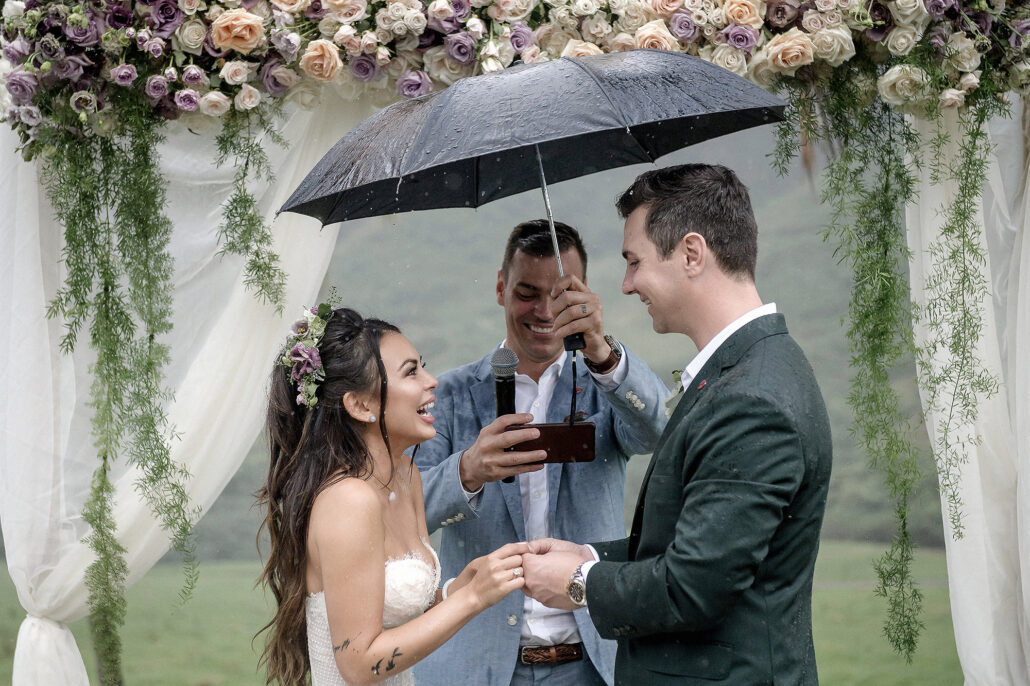
A philosopher would look at a wedding and see courage. Two people standing in front of witnesses and saying, out loud, that they have chosen each other. Not privately, which would be easier. Publicly. In a room where people can hear them.
That is not a small act. Philosophers from Kierkegaard to Simone de Beauvoir have wrestled with what it means to commit to another person in full view of a community. It requires you to be seen before you know how the story ends. To say “this is what I have chosen” while knowing that the future is unwritten and the people listening will remember.
Every ceremony, regardless of its setting or structure, is an act of public vulnerability. Two people agreeing to be known, not just by each other, but by everyone in the room.
A Tribal Bonding Ritual
An anthropologist would see something older. A pattern that predates written language. Two individuals declaring an alliance, and a community reorganising itself around that declaration.
This is what anthropologists mean when they talk about ritual. Not decoration. Not tradition for its own sake. Ritual as social technology. A mechanism through which a group of people collectively agree that something has changed. Before the ceremony, these were two separate people with two separate networks. After it, they are a unit, and the community that witnessed it has been restructured, however subtly, around that new reality.
Every culture on earth has done this. The specifics vary. The function never does.
A Memory Anchor
A psychologist would point to the way memory works. We do not remember our lives in a steady stream. We remember peaks. Moments of heightened emotion that pin the timeline in place and give structure to the years on either side.
A wedding is one of the most powerful memory anchors a human being can experience. Not because of the flowers or the venue or the playlist, but because of the emotional intensity of the moment itself. The brain encodes experiences more deeply when emotion is present, and a wedding concentrates more emotion into a shorter window than almost any other life event.
Years later, people do not remember the details. They remember how the room felt. They remember the look on someone’s face. They remember the moment that made them cry, even if they cannot explain why. The anchor holds, long after the specifics have softened.

A Synchrony Event
A neuroscientist would zoom further in. Past the emotions, past the memories, into the brain itself. And what they would find is synchrony. Neural oscillations aligning across individuals who are sharing the same experience in real time.
This is not metaphor. It is measurable. When a group of people witness the same emotionally significant moment, their brain activity begins to mirror each other’s. Heart rates align. Breathing patterns converge. The room, for a few seconds, becomes neurologically unified.
Research in social neuroscience has documented this phenomenon in shared rituals, live music, and collective experiences of awe. A wedding ceremony, particularly the moment of commitment, is one of the most potent triggers for this kind of neural coupling. The people in the room are not just watching. Their brains are participating.

Collective Effervescence
A sociologist would use Emile Durkheim’s term. Collective effervescence. The state that emerges when a group of individuals transcends their separateness and becomes, for a moment, something larger.
Durkheim observed this in religious ceremonies, festivals, and communal gatherings. The energy in the room shifts. People feel more connected, more alive, more willing to be generous with their emotions than they would be alone. It is not manufactured. It cannot be faked. It arises from the convergence of people, intention, and shared experience.
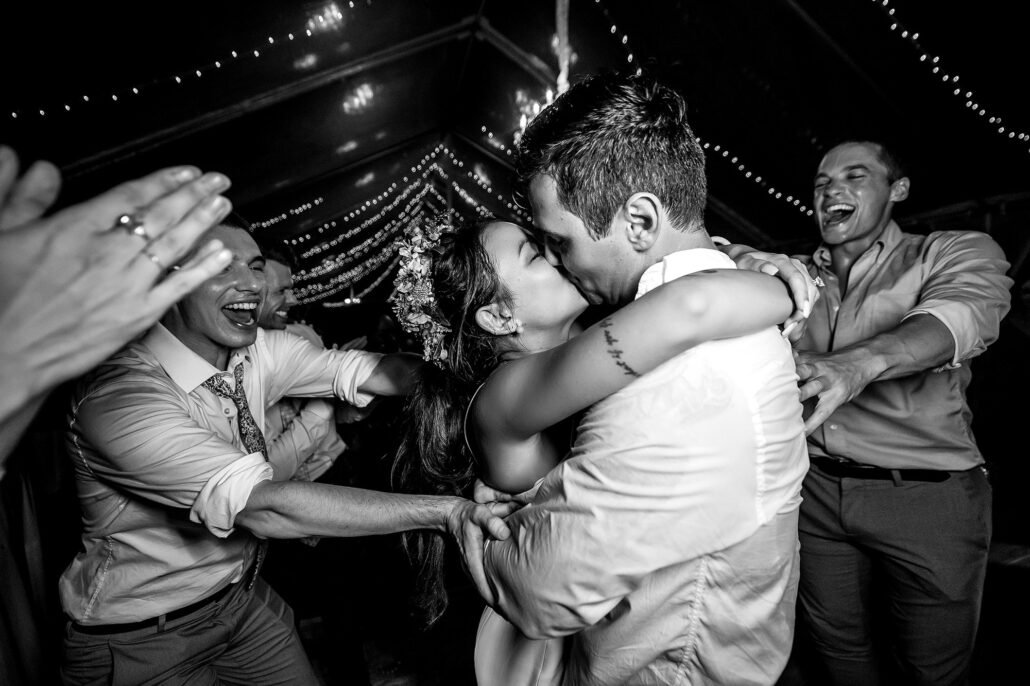
Anyone who has been in a room when a ceremony lands, truly lands, has felt this. The moment when the collective breath catches. When the energy shifts from observation to participation. That is effervescence. And it does not require production value to occur. It requires sincerity.

An Investment in Social Capital
An economist would see networks. A wedding brings together people who would not otherwise be in the same room. Your oldest friend and your partner’s sibling. Your parents and your colleagues. People drawn from entirely separate chapters of two separate lives, placed together for a concentrated period of shared experience.
The bonds formed in that space are not incidental. They are social capital. Relationships strengthened, new connections forged, a broader and more resilient network built around the newly joined unit. Economists who study social capital consistently find that the density and quality of a person’s relationships are among the strongest predictors of long-term wellbeing.
A wedding is, among many other things, one of the most efficient social capital events a person will ever host. Not because of the size of the guest list, but because of the depth of the gathering.

The Bravest Thing Two People Can Do
And then there is the poet’s view. Simpler. Less interested in mechanisms and more interested in what it feels like to stand up in front of the people you love and say: this person. This life. I choose this.
A poet would call it bravery. The quiet kind. The kind that involves standing still rather than running. The kind that says something true out loud, knowing it cannot be unsaid, and choosing to say it anyway.
Every other discipline explains why weddings work. The poet explains why they matter.

All of These, in a Single Room
Here is what is remarkable. Every one of these perspectives is operating simultaneously. The philosophy, the anthropology, the psychology, the neuroscience, the sociology, the economics, the poetry. All of it happening at once, in the same room, during the same ceremony.
No couple is thinking about neural synchrony while they say their vows. No guest is calculating social capital while they wipe their eyes. But the forces are there, working underneath the moment, giving it a weight that everyone can feel even if nobody can name it.
That is what a wedding is. Not one thing. Many things, layered so densely that the experience exceeds any single explanation. It is humanity, condensed into a room.
And not one of those layers requires a particular venue, a particular budget, or a particular guest count. They require people who mean it, a moment held with intention, and the courage to let it be witnessed.


