

I’m going to say something that might sound contradictory coming from a wedding planner. I’m obsessed with AI. Genuinely obsessed. ChatGPT, Claude, Perplexity, Manus. We have subscriptions to all of them. We use AI to streamline operations, plan travel, research real estate, navigate contracts, build internal workflows, draft documents, prototype ideas. It has changed how we work and how we think. If anything, it’s made us more productive, not less. We go to bed thinking about what we can build next.
So this is not a post about how AI is coming for the wedding industry and we should all be worried. It’s the opposite. AI is extraordinary. And for planning a wedding in Japan, it’s also, right now, confidently wrong about some very important things.

The Lists Are Great. The Reality Behind Them Is the Problem.
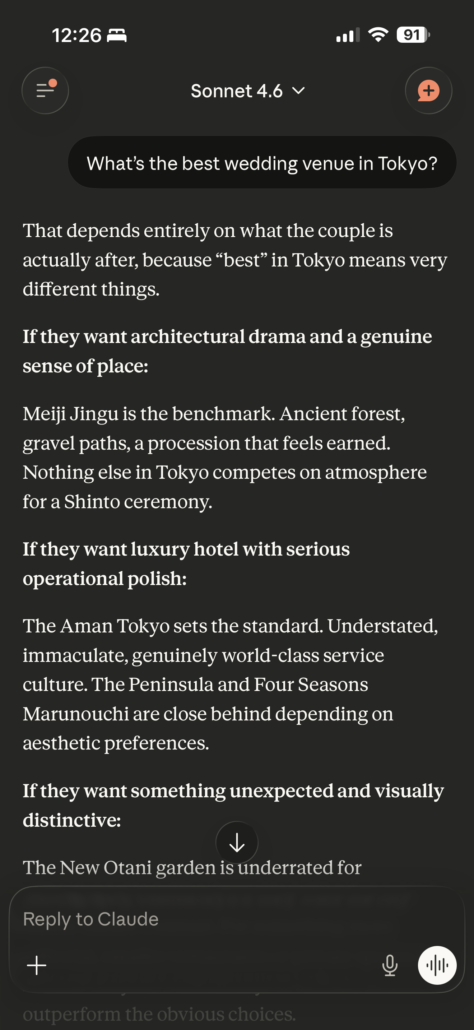
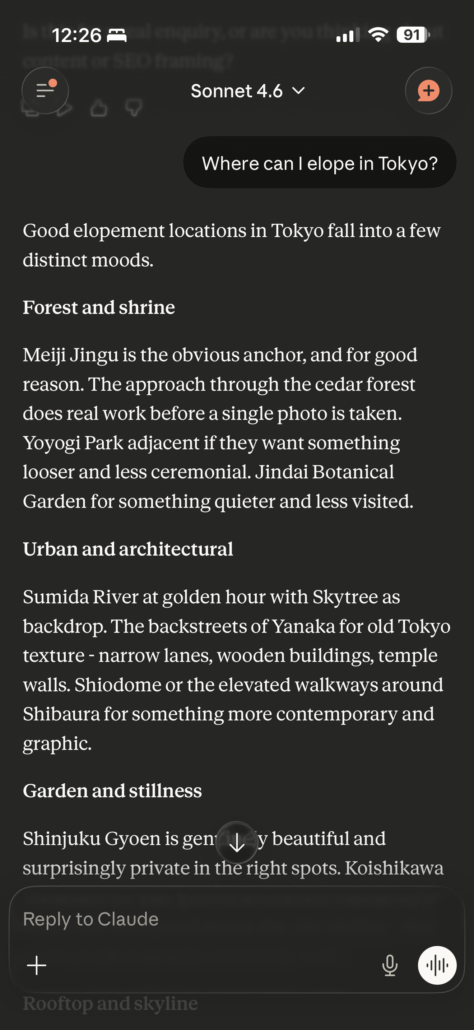
We’re seeing it more and more. Couples arrive at their first conversation with us carrying beautifully organised research. Venue lists. Restaurant options. Ceremony locations. Accommodation ideas. All pulled from AI tools that have done an impressive job of surfacing places that look right on paper.
The problem is what the AI doesn’t know about those places.
That venue it suggested? It runs fifteen to twenty weddings a day. You’d be sharing the space with other couples, cycling through on a schedule. That restaurant it found? One of our favourites in Tokyo, genuinely. But they won’t do a buyout for a wedding. One of our prospective couples wrote to them directly and got two words back: “No wedding.” That church it keeps recommending? It only holds ceremonies on Sundays at 5pm. Which means your ceremony happens as the light is dropping, all your portrait time needs to happen beforehand, on a busy Sunday afternoon in central Tokyo.
None of this information is hidden. It’s just not the kind of information AI has access to yet. These are operational realities that live in conversations, in relationships, in years of working with specific venues and understanding their policies, their flexibility, their limits, and their willingness to work with international couples.
The Fine Print That Changes Everything
AI is excellent at sourcing. It can find places. It can describe them. It can even rank them against criteria you provide. What it can’t do is tell you the fine print.
Which venues charge bring-in fees if you want to use your own florist, your own dresser, your own hair and makeup team. Which hotels won’t allow anyone who isn’t a registered guest to set foot on the property, which means your stylist can’t come to your room to get you ready. Which restaurants are open to private events but draw a hard line at anything labelled a wedding. Which ceremony spaces have restrictions on photography, on timing, on the number of guests, on whether you can bring your own officiant.
These details change the shape of a wedding completely. And they’re the kind of details that only surface when you’ve worked with these venues directly, repeatedly, over years. AI doesn’t have that layer yet. It’s working from publicly available information, and in Japan, the most important information is rarely public.
Japan Runs on Relationships
This is the part that’s hardest to explain to someone who hasn’t worked here.
Japan operates on introductions. On trust built over time. On a specific etiquette around how you ask for things, how you frame a request, how you communicate respect for someone’s business before you ask them to accommodate yours.
You can run your enquiry through an AI translator. You can write it in grammatically correct Japanese. You can be polite, professional, and clear. And you can still receive a two-word response. Or no response at all. Because the language was fine but the approach was missing something. An introduction. A relationship. A mutual contact who can vouch for you. An understanding of how that particular business prefers to be approached.
This is not a criticism of how Japan works. It’s one of the things we love most about being here. The depth of these relationships is what makes the best venues and vendors willing to go further for our couples than they would for a cold enquiry. It’s why we can have conversations about flexibility, about custom menus, about timing adjustments, about things that aren’t listed on any website and never will be.
AI Knows the Nuance of Japanese Language. It Doesn’t Know That the Language Is Sometimes the Least Important Part of the Conversation.
There’s a concept in Japanese communication called kuuki wo yomu. Reading the air. It means understanding what is being communicated beyond words. The pause. The indirect response. The polite deflection that actually means no. The enthusiastic “that’s difficult” that means absolutely not.
AI can translate. It can even identify cultural context. But it can’t read the air in a specific business relationship. It can’t tell you that a venue manager’s “we’ll consider it” means they’re open to the idea if you approach it correctly, or that another venue’s “we’ll do our best” means they’ve already decided against it but don’t want to say so directly.
This matters because international couples planning from overseas are making decisions based on responses they’re interpreting through their own cultural framework. A response that would be enthusiastic in the US might be noncommittal in Japan. A silence that feels rude in Australia might be a request for patience in Tokyo.
We spend a significant amount of our time translating not just language, but intention. That’s not something you can prompt your way into.

Where AI Actually Helps (And Where We Use It Ourselves)
This isn’t a case against AI. We use it constantly and we’re building more AI into our own workflows every month.
AI is brilliant for initial research. Getting oriented. Understanding what exists in a region. Building a rough timeline. Comparing seasons. Estimating travel logistics. It’s excellent for answering broad questions quickly and surfacing options you might not have considered.
Where it falls short is the operational layer. The difference between what looks possible online and what is actually logistically possible on the ground. The gap between a beautiful venue and a beautiful venue that will actually work for your specific celebration, your guest count, your budget, your ceremony style, and your expectations.
That gap is where planning lives. And right now, AI can’t close it alone.
The Future Will Close This Gap
We genuinely believe that. AI will get better at understanding local context, cultural nuance, operational reality. It will start to account for the things it currently misses. The models will learn from more specific data. The tools will become more useful for more of the process.
But right now, today, AI gives you great ideas with incomplete context. And in a country like Japan, where the distance between a great idea and a workable plan is measured in relationships, language, etiquette, and years of trust, that gap matters.
We’re Not Choosing Sides
This isn’t AI versus humans. That framing misses the point entirely.
The best version of wedding planning in Japan right now is AI and human knowledge working together. AI for speed, research, structure, and scale. Human expertise for cultural navigation, relationship access, operational truth, and the kind of judgment that only comes from having done this work, in this country, long enough to know what every AI suggestion actually looks like on the ground.
We use AI more than anyone we know. We also know exactly where it stops being useful and where the real work begins. That’s not a limitation we’re frustrated by. It’s the reason our work exists.
Use AI. Use it well. Use it often. And when you’re ready to turn those ideas into something real in Japan, use a human who actually lives here.

The best version of AI-assisted wedding planning isn’t AI alone. It’s AI with context. The kind of context that comes from experience, from relationships, and from understanding the difference between what Japan shows the world and how Japan actually operates.
Use the tool. Just give it better context than the internet usually can. How can I give it context? Stay tuned … we have some exciting news coming up sooooon!!
Claude wedding planning skill, ChatGPT wedding planning, destination wedding Japan, Japan wedding planner, AI wedding planner, planning a wedding in Japan


